Chemicals can present serious safety hazards if not stored correctly. Australia has a wide range of safety standards that govern the storage of various chemicals. These regulations exist to protect public safety, the environment and against legal liabilities.
In this guide, we will explore the importance of choosing compliant chemical storage tanks and the Australian and specific standards that need to be followed to ensure safe storage.
Importance of Compliance Chemical Storage Tanks
Investing in compliance chemical storage tanks is crucial for maintaining a safe environment and protecting against hazards and legal issues. Many liquid chemicals including fertilisers and diesel are highly flammable and combustible. Correct, compliant storage ensures that you can store these dangerous chemicals for use while maintaining safety and peace of mind for all.
Chemical Compatibility Considerations
Our polyethylene tanks are designed to provide excellent resistance to a wide variety of chemicals. However, it’s important to note that chemical storage and compatibility cannot be determined by name alone.
Tank suitability, safety, and compliance depends on several factors:
- Chemical name and Safety Data Sheet (SDS)
- Concentration or dilution rate
- Storage temperature and operating temperature
- Exposure duration
- Whether the product is being mixed, agitated or recirculated
- Any other chemicals that may be added to the tank
Many chemicals can degrade, damage, or cause polyethylene tanks to swell, resulting in stress cracking, leakage, and serious safety concerns. For this reason, it’s essential to consult experts prior to purchasing a tank.
At Global Rotomoulding, we review chemical applications with our raw material suppliers and chemical resistance data providers before recommending a chemical storage tank. If you provide the chemical name, concentration, SDS and expected operating conditions we can complete a detailed assessment to ensure you get the right solution for safety, compliance, and peace of mind.
Why Chemical Compatibility Matters When Selecting a Polyethylene Tank
When it comes to storing chemicals, not all applications are the same.
Polyethylene tanks are widely used throughout agriculture, manufacturing, water treatment and industrial industries because of their durability and excellent resistance to many chemicals. However, chemical compatibility is not as simple as matching a chemical name to a tank.
The concentration of the chemical, storage temperature, operating conditions and even what was previously stored in the tank can all influence long-term performance.
Not All Chemicals Behave the Same
Many common agricultural and industrial products are well suited to polyethylene storage tanks, including a range of fertilisers, acids, alkalis, salts and water treatment chemicals.
Examples of products that are commonly compatible with polyethylene under many operating conditions include:
- Hydrochloric Acid
- Sulphuric Acid (at many concentrations)
- Phosphoric Acid
- Sodium Hydroxide (Caustic Soda)
- Sodium Hypochlorite
- Ammonium Sulphate
- Aluminium Sulphate
- Calcium Chloride
- Copper Sulphate
- Citric Acid
- Water and Brine Solutions
However, compatibility can change dramatically as concentration increases or operating temperatures rise. A chemical that performs well at ambient temperatures may not be suitable at elevated temperatures. Likewise, products that are safe at low concentrations may require additional consideration when stored in stronger solutions.
This is why chemical storage should never be based solely on the name of the product.
Australian Safety Standards for Chemical Storage
Australia has a few safety standards that apply to the whole country and all industries storing dangerous chemicals on-site. These include Work Health and Safety regulations and AS1940:2017. Each state and territory, and individual industries also have specific regulations to ensure the safe storage of chemicals. All relevant standards and regulations must be met to ensure full safety and compliance.
Work Health and Safety (WHS) Regulations
Under Work Health and Safety (WHS) framework in Australia, all hazardous chemicals, including flammable and combustible liquids, must be stored securely and with clear management framework, such as:
- Safe Chemical Storage containers with clear handling systems, signage, and manifests for storage above 500L or 500kg.
- Risk Management Plan that identifies potential hazards, risks, and control measures.
- Emergency Plans to manage potential incidents involving the stored chemicals.
- Training for any personnel who may be handling the chemicals and responsible for enacting emergency procedures in the event of an emergency.
These regulations are enforced by Safe Work Australia and corresponding state agencies to ensure the safe storage and management of hazardous chemicals and potential emergencies.
AS1940:2017 — The Storage and Handling of Flammable and Combustible Liquids
In Australia, AS1940:2017 is the primary standard governing the storage and handling of flammable and combustible liquids. This standard outlines the design, construction, and maintenance of chemical storage tanks and facilities, and is mandatory across all states and territories.
Key provisions of this standard, include:
- Design and Construction: Chemical storage tanks must be made from materials suitable to the particular liquid to ensure structural integrity and compatibility.
- Ventilation: Storage tanks or facilities must provide adequate ventilation to prevent the accumulation of flammable vapours.
- Spill Containment: Facilities must have effective measures in place to contain spills.
- Distances: Minimum separation distances between storage tanks and property boundaries or protected places must be maintained to minimise potential incidents.
- Ignition Source Control: Measures must be in place to keep ignition sources a safe distance from liquid chemicals.
AS/NZS 4766 — Rotationally moulded buried, partially buried and non-buried storage tanks for water and chemicals
AS/NZS 4766 is the Australian standard that specifies the requirements for the design and manufacture of rotationally moulded, seamless polyethylene storage tanks. This standard is designed to ensure that these tanks are safe and secure for storing water and chemicals.
Key aspects of this standard include:
- Seamless Construction: Rotomoulded chemical storage tanks must be manufactured as a single-piece seamless construction with no joints or seams to prevent weak spots and leaks.
- Material Quality: Tanks must be constructed from high-quality, food-grade, UV-stabilized polyethylene.
- Wall Thickness: No section of the tank can be less than 4.5 mm thick, to ensure the tank can withstand long-term liquid pressure.
- Testing & Traceability: Manufacturers must perform rigorous testing, such as impact and ultrasonic thickness tests, to guarantee structural integrity.
State and Territory Regulations
The national standards above must be followed across Australia. However, each state and territory also has its own additional framework that must also be met to ensure safety and compliance.
Specific state and territory legislation includes:
- ACT: Work Health and Safety Regulation 2011: WorkSafe ACT Dangerous Substances Framework
- New South Wales: SafeWork NSW Storage and Handling of Dangerous Goods Code of Practice
- Northern Territory: Work Health and Safety (National Uniform Legislation) Act 2011 and Regulations, and NT WorkSafe Hazardous Chemicals Code of Practice
- Queensland: WorkSafe QLD Managing Risks of Hazardous Chemicals Code of Practice
- South Australia: Work Health and Safety Act 2012 (SA) and Work Health and Safety Regulations 2012: SafeWork SA Managing Risks of Hazardous Chemicals Compliance Code
- Tasmania: Work Health and Safety Regulations 2022: WorkSafe Tasmania Dangerous Goods Framework
- Western Australia: Dangerous Goods Safety Act 2004 and the Dangerous Goods Safety (Storage and Handling of Non-Explosives) Regulations 2007
- Victoria: Dangerous Goods Act 1985 and the Dangerous Goods (Storage and Handling) Regulations 2022
Industry-Specific Regulations
In addition to national and state regulations, there are also specific requirements for various industries that require chemicals for their operations, such as agriculture, mining, and food and beverage businesses. It’s essential to familiarise yourself with the regulations for your specific industry when planning to store hazardous chemicals onsite.
For example, farmers often need to store large amounts of diesel for their machinery and fertilisers for crop management. When storing these chemicals, farmers need to ensure that tanks are appropriately designed and located to maintain compliance and prevent contamination of soil and water sources.
Mining industries also require large volumes of diesel and chemicals for operations. Due to the harsh environmental conditions on mine sites, it’s crucial that chemical storage tanks are durable.
Additional Safety Procedures
In addition to the standards outlined in the Australian, state, and industry Standards, it’s important to always take care when handling chemicals.
Wash Down Before Changing Chemicals
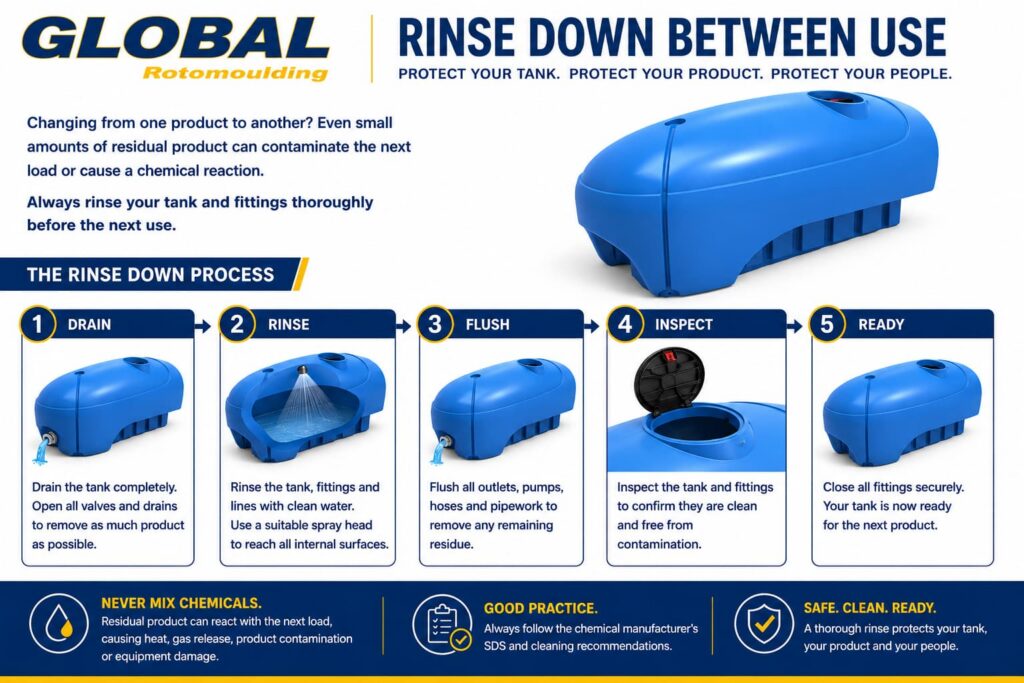
One of the most common causes of problems in chemical storage is changing products without properly cleaning the tank. Care should always be taken when changing the chemical stored within a tank. Even if two chemicals are individually compatible with polyethylene, they may react when mixed together. Small amounts of residue left in tanks, valves, pumps or pipework can sometimes lead to contamination, heat generation, gas release or unwanted chemical reactions.
Before adding a new or different chemical to a tank, make sure that the tank, pipework, valves and pumps are all thoroughly drained, cleaned and washed down in accordance with the chemical manufacturer’s recommendations. This helps to avoid potential chemical reactions, contamination, heat generation, gas release, damage to the tank and associated equipment, and improves safety for operators.
Where there is any uncertainty regarding chemical compatibility, cleaning procedures or changeover requirements, customers should consult both the chemical supplier and Global Rotomoulding prior to use.
Contact Us Before You Store Chemicals
Compliant chemical storage is essential not just for avoiding legal penalties, but also for protecting the environment and ensuring safety for personnel.
Chemical storage is a critical application and every situation is different. By providing the chemical name, SDS, concentration and operating temperature, our team can work with material suppliers and chemical compatibility data to help determine whether a polyethylene tank is suitable for your application.
A short conversation before purchase can help prevent costly mistakes and ensure your tank delivers safe, reliable performance for years to come. If you’re planning to store chemicals, contact Global Rotomoulding and we’ll help assess the application before you buy.
Important Notice
Chemical resistance information is provided as a guide only and should not be considered a guarantee of field performance. The long-term suitability of any tank is influenced by factors including tank design, processing, installation, operating conditions, chemical concentration and temperature. Final suitability should always be confirmed before storage of any chemical product.