Choosing the wrong chemical storage tanks for your farm can be a costly mistake. Whether it’s a tank that degrades from chemical or UV exposure or a tank that’s too small for your needs, the wrong decision can lead to headaches, extra work or costs.
The right tank, on the other hand, ensures safe, compliant storage for your fertilisers or other chemicals, protecting your property, livelihood and peace of mind. However, with so many options available it can be difficult to know what you need. Let’s explore some key tips to choosing the right chemical storage tank for your agricultural needs.
Tips for Choosing the Right Chemical Storage Tanks
Whether you manage livestock or crops, safe chemical storage is essential for ensuring efficiency, productivity and compliance. Choosing the right tank is the key to making sure you always have the right amount of fertiliser or chemicals on hand when you need them.
When it comes to selecting the ideal chemical storage tank, there are a number of factors to consider, including the types of chemicals you need, how much you need, the ideal shape, whether it needs to be portable, the right materials, and your compliance requirements.
Understanding Chemical Compatibility
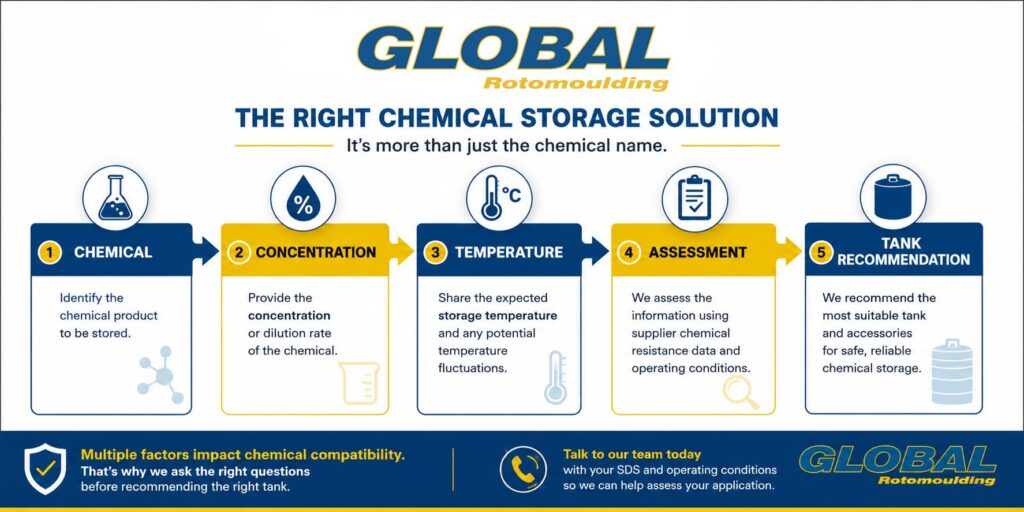
When it comes to storing chemicals, not all applications are the same. Polyethylene tanks are widely used throughout agriculture because of their durability and excellent resistance to many chemicals. However, chemical compatibility is not as simple as matching a chemical name to a tank. The concentration of the chemical, storage temperature, operating conditions and even what was previously stored in the tank can all influence long-term performance.
The suitability of a tank for your farm will depend on several factors, including:
- Chemical name and Safety Data Sheet (SDS)
- Concentration or dilution rate
- Storage temperature and operating temperature
- Exposure duration
- Whether the product is being mixed, agitated or recirculated
- Any other chemicals that may be added to the tank
Many chemicals can attack, degrade, soften or cause swelling of polyethylene. Other products, including some detergents, surfactants, alcohols, oils and solvents, may also increase the risk of environmental stress cracking, particularly where the tank is subjected to mechanical stress or elevated temperatures. Chemical compatibility can also change significantly as concentration and temperature increase.
Many common agricultural products are well suited to polyethylene storage tanks, including a range of fertilisers, acids, alkalis, salts and water treatment chemicals. Chemicals that are commonly compatible with polyethylene under many operating conditions include:
- Hydrochloric Acid
- Sulphuric Acid (at many concentrations)
- Phosphoric Acid
- Sodium Hydroxide (Caustic Soda)
- Sodium Hypochlorite
- Ammonium Sulphate
- Aluminium Sulphate
- Calcium Chloride
- Copper Sulphate
- Citric Acid
- Water and Brine Solutions
However, compatibility can change dramatically as concentration increases or operating temperatures rise. A chemical that performs well at ambient temperatures may not be suitable at elevated temperatures. Likewise, products that are safe at low concentrations may require additional consideration when stored in stronger solutions. This is why chemical storage should never be based solely on the name of the product.
When you contact Global Rotomoulding, we will review chemical applications with our raw material suppliers and chemical resistance data providers before recommending a storage solution. Simply provide the name of the chemical you need to store, the concentration, SDS and expected operating conditions to allow an assessment to be completed, and we can then provide tailored advice to help you find the right chemical storage tank for your farm.
Know Your Capacity Needs
Next, consider your capacity requirements. Tanks that are too small can lead to running out early and needing constant refilling, wasting time and doubling efforts. However, bigger isn’t always best either. A tank that’s too big can lead to chemicals sitting too long, which can reduce efficacy.
When choosing the right tank size, consider:
- Peak-season Volume — What’s the maximum amount of chemicals you need on hand at any given time?
- Delivery or Accessibility — How often do you receive chemicals or how often can you collect them and how much can you get at a time?
- Future Growth — Are your operations or needs growing? Will the tank you get now suit future needs?
Consider Tank Shapes & Designs
Chemical storage tanks come in a variety of shapes and designs to suit unique needs. From round, flat-bottom tanks to cone-bottom tanks and cylindrical cartage tanks, there are options for every need.
- Round, flat-base tanks offer stable, long-term storage. They are ideal for permanent installations where the priority is volume rather than portability or mixing.
- Cone-bottom tanks are purpose-built for complete drainage. The tapered base supports simple mixing and ensures that important nutrients or chemicals don’t settle on the base.
- Cartage tanks offer smaller volume holding and effective transportation. Their compact size supports cartage on the back of utes or light vehicles, perfect for getting chemicals to machinery or remote paddocks or pastures.
Stationary vs Cartage Tanks
Next, consider your operations and how you use the chemicals you’re storing. Some operations run bulk storage in a shed and pump to smaller units for application. Others need to transport chemicals directly to different paddocks or properties.
Large, stationary tanks are ideal for storing or mixing high volumes of chemicals in a centralised location. Conversely, cartage tanks are ideal for moving chemicals across large properties to spray or dispense directly from the tank to the paddock.
Spending on your operations, you may even need a combination of tanks to support your needs.
Choose the Right Material
The material that your tank is constructed from is one of the most important factors. Chemicals and harsh Australian conditions can corrode certain materials, leading to early replacement. High-strength, chemical-resistant materials, such as rotomoulded plastic offer long-lasting safety and storage solutions.
Rotomoulded plastics have no weld points, joints, or seams that can crack, corrode, or become failure points under chemical exposure. They are also UV stabilised to withstand the harsh Australian sun when stored outside.
UV exposure and temperature are two of the most commonly overlooked factors in chemical storage. As temperatures increase, chemical reactions generally become more aggressive. A chemical that can be safely stored at 20°C may have different compatibility characteristics at 40°C, 60°C or higher.
For this reason, we always recommend discussing both the normal storage temperature and any potential temperature fluctuations with our team to ensure that your chosen tank will withstand your unique conditions, temperatures and be compatible with your specific chemicals.
Compliance & Safety Considerations
Chemical storage on Australian farms is governed by a combination of state environmental regulations and Australian Standards. Requirements vary by state and by the classification and volume of chemicals being stored.
So, it’s essential to check that the tank meets the requirements in your local area for the chemicals you need to store. Additionally, a complex assessment from our team at Global Rotomoulding can help ensure that you get the right tank for your needs.
Change of Chemicals
Moreover, if you plan to use the tank for storing different chemicals, care must be taken when changing the chemical stored within the tank. Even if two products are individually compatible with polyethylene, they may react adversely when mixed together.
Before introducing a new chemical, tanks should be thoroughly drained, cleaned and washed down in accordance with the chemical manufacturer’s recommendations. Residual product left in the tank, pipework, valves or pumps may cause chemical reactions, contamination, heat generation, gas release, damage to the tank and associated equipment, or present safety hazards.
Where there is any uncertainty regarding chemical compatibility, cleaning procedures or changeover requirements, customers should consult both the chemical supplier and Global Rotomoulding prior to use.
Select the Right Chemical Storage Tank for Your Farm
Chemical storage is a critical application and every situation is different. When you choose the right tank, you will have peace of mind that your farm is safe, compliant, and that your tank will last for many years. A short conversation before purchase can help prevent costly mistakes and ensure your tank delivers safe, reliable performance for years to come.
By providing the chemical name, SDS, concentration and operating temperature, our team can work with material suppliers and chemical compatibility data to help determine whether a polyethylene tank is suitable for your application.
At Global Rotomoulding, we build and deliver purpose-built chemical storage tanks to support safe, durable, and compliant storage for agricultural operations. Using precision moulding technology, every tank is manufactured for strength, durability, and reliability. Our tanks meet all relevant Australian standards and withstand tough Australian conditions, while also supporting sustainable production to minimise environmental impacts.
If you’re searching for a chemical storage tank for your farm, contact Global Rotomoulding and we’ll help assess the application before you buy.
Important note
Chemical resistance information is provided as a guide only and should not be considered a guarantee of field performance. The long-term suitability of any tank is influenced by factors including tank design, processing, installation, operating conditions, chemical concentration and temperature. Final suitability should always be confirmed before storage of any chemical product.