Transporting liquids may seem straightforward, but things can go wrong quickly, causing stress, disruptions, and serious hazards depending on what you’re transporting. Liquid shifts and moves inside cartage tanks, in ways that solids don’t. This can cause trailers to sway or place structural stress on the cartage tank.
Understanding baffling, load management, and safe transport practices can help ensure smooth transportation of liquids.
What is Baffling and How Does it Work?
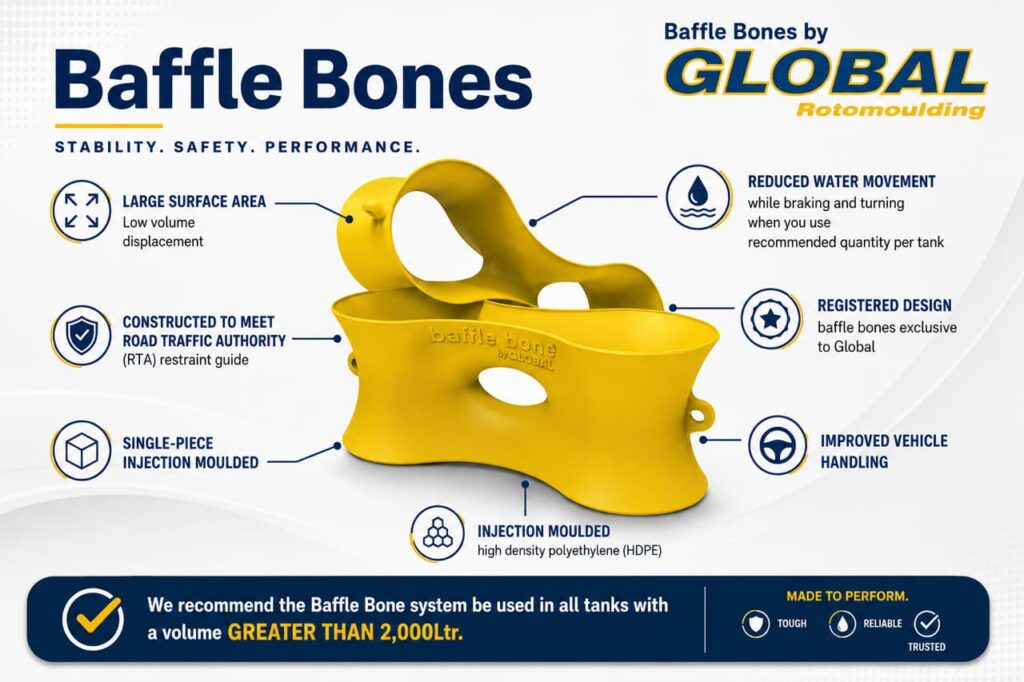
A baffle is an internal partition or divider within a tank that limits the movement of liquid inside cartage tanks. Baffling helps to reduce sloshing, in turn keeping vehicles stable when you brake, turn, or speed up. This enhances safety by reducing the risk of weight shifts which can make trailers sway, vehicles to become difficult to steer, and roll overs. Moreover, it protects the integrity of the cartage tank by reducing stress and friction, as well as preventing damage to your vehicle’s brakes, tyres, and suspension.
Unbaffled tanks rely on the operator correctly managing fill levels and driving to the conditions of the moving liquid and weight shifts.
At Global Rotomoulding, we supply a wide range of baffled cartage tanks for water, diesel and other chemicals, available in various sizes including 200L, 400L and 800L.
Tips for Safely Transporting Liquids in Cartage Tanks
Whether or not you opt for a cartage tank with built-in baffling, there are a number of steps you should always take to ensure the safe transport of liquids.
Managing fill levels for safe transport
For best results and safety, you should never transport a tank that is between 20% and 80& full, as this zone presents the highest risk of water movement and weight shifts.
For best practice, keep your cartage tank at the following levels:
- 90-100% Capacity: A full tank presents the least room for liquid movement inside the tank, thus keeping the tank and your vehicle steady.
- Under 20% Capacity: Low volume translates to low mass, so even if there is some movement, it should be low-impact and manageable.
If partial fill between 20-80% capacity is unavoidable, it is essential to drive more carefully. Reduce speed, take corners slowly, and increase following distances.
Securing the tank on the vehicle
Full cartage tanks are heavy and while moving it can be easy for them to fall off your tailor or vehicle if they are not secured appropriately. Many cartage tanks are designed to be strap mounted, allowing the tank to be secured to the vehicle or trailer using straps.
For best security, attached tanks with at least two straps, one on each end of the tank. Make sure to always secure tanks through dedicated anchor points or cradle frames to ensure minimal movement. It’s also good practice to check tie straps after the first 5-10km of travel to ensure that they are still secure, as liquid movement can compress any slack and shift the load.
Additionally, ensure the cartage tank is over or ahead of the trailer axle where possible to minimise the risk of sway and allow for maximum control.
Vehicle and trailer suitability
One of the most important steps when transporting anything is to ensure that the vehicle’s tow rating is matched to the weight being transported. Never attempt to transport a load that is heavier than your vehicle is rated to as this can present serious compliance and safety risks and potentially damage your vehicle.
It’s important to remember that certain liquid chemicals such as fertilisers are denser and therefore heavier than water. A 200L cartage tank full of water will be 200kg, however the same tank full of liquid fertiliser can weigh between 220 -270 kg. For this reason, it’s important to confirm the vehicle’s rating against the weight of what you’re actually transporting, not just the size of the tank.
Safe driving practices with a loaded cartage tank
Safe driving practices are always essential, however, there are some factors that need to be kept in mind when transporting liquids:
- Increase following distances: a vehicle transporting liquids can take longer to stop than one with solid-cargo due to movement or surges adding forward momentum to the braking load.
- Reduce cornering speeds: liquids can shift during turns causing vehicles to sway or add momentum in the opposite direction.
- Avoid sudden steering corrections: if sway develops or momentum from liquid movement pulls your vehicle, the instinct to counter-steer sharply can amplify the problem. Instead, it’s critical to maintain steady control.
- Take graded or unsealed roads at reduced speed: uneven or rough surfaces can generate rapid liquid movement inside tanks that can cause sway, loosen tie-downs or stress tank fittings.
- Pre-trip inspection: check all outlet valves and caps are closed and the tank is secured before moving off.
Fitting and valve maintenance
Inspect all outlet valves, cap fittings, and inlet seals before transport. If any fittings are not fully closed or if any leak, it not only wastes your liquid but it can also present serious safety hazards. Many liquid chemicals are combustible, meaning they can catch fire or explode if they come in contact with sparks or hot vehicle parts. Moreover, liquid chemicals can emit hazardous fumes, which can cause serious health concerns if breathed in during transport.
Additionally, if you’re transporting more than one liquid chemical and they mix it can cause serious reactions, depending on the chemicals.
Safe, Compliant Liquid Chemical Transportation
If you plan to transport liquid chemicals, it is essential that you invest in a compliant chemical cartridge tank to ensure safety. Many liquid chemicals including fertilisers and diesel are highly flammable and combustible, which can pose serious safety risks during transportation. Choosing compliant tanks ensures that you can store these hazardous chemicals for use while maintaining safety and peace of mind.
Cartage tank suitability, safety, and compliance depends on several factors:
- Chemical name and Safety Data Sheet (SDS)
- Concentration or dilution rate
- Storage temperature and operating temperature
- Exposure duration
- Whether the product is being mixed, agitated or recirculated
- Any other chemicals that may be added to the tank
Many liquid chemicals can degrade, damage, or cause polyethylene tanks to swell, resulting in stress cracking, leakage, and serious safety concerns. For this reason, it’s crucial to consult experts prior to purchasing a tank.
At Global Rotomoulding, we review chemical applications with our raw material suppliers and chemical resistance data providers before recommending a tank for chemical storage or transportation. If you provide the chemical name, concentration, SDS and expected operating conditions we can complete a detailed assessment to ensure you get the right cartage tank solution for safety, compliance, and peace of mind.
Ensure Safe Liquid Transport with Compliant Cartage Tanks
Proper preparation, careful driving, and investing in the right cartage tank are all essential for ensuring the safe transport of liquids, including water, diesel, fertilisers, and other liquid chemicals.
Whether you need to transport water for farm animals, diesel for refuelling vehicles across large properties, or liquid fertilisers to support healthy crops, Global Rotomoulding supplies a wide range of cartage tanks in various sizes and for various liquids.
However, it’s important to note that a short conversation before purchase can help prevent serious safety risks, compliance issues, and ensure your cartage tank delivers safe, reliable performance. If you’re planning to store or transport liquid chemicals, contact Global Rotomoulding and we’ll help assess the application before you buy.
Important Notice
Chemical information is provided as a guide only and should not be considered a guarantee of field performance. The suitability of any tank is influenced by factors including tank design, processing, operating conditions, chemical concentration and temperature. Final suitability should always be confirmed before storage or transportation of any chemical product.